
 Deva
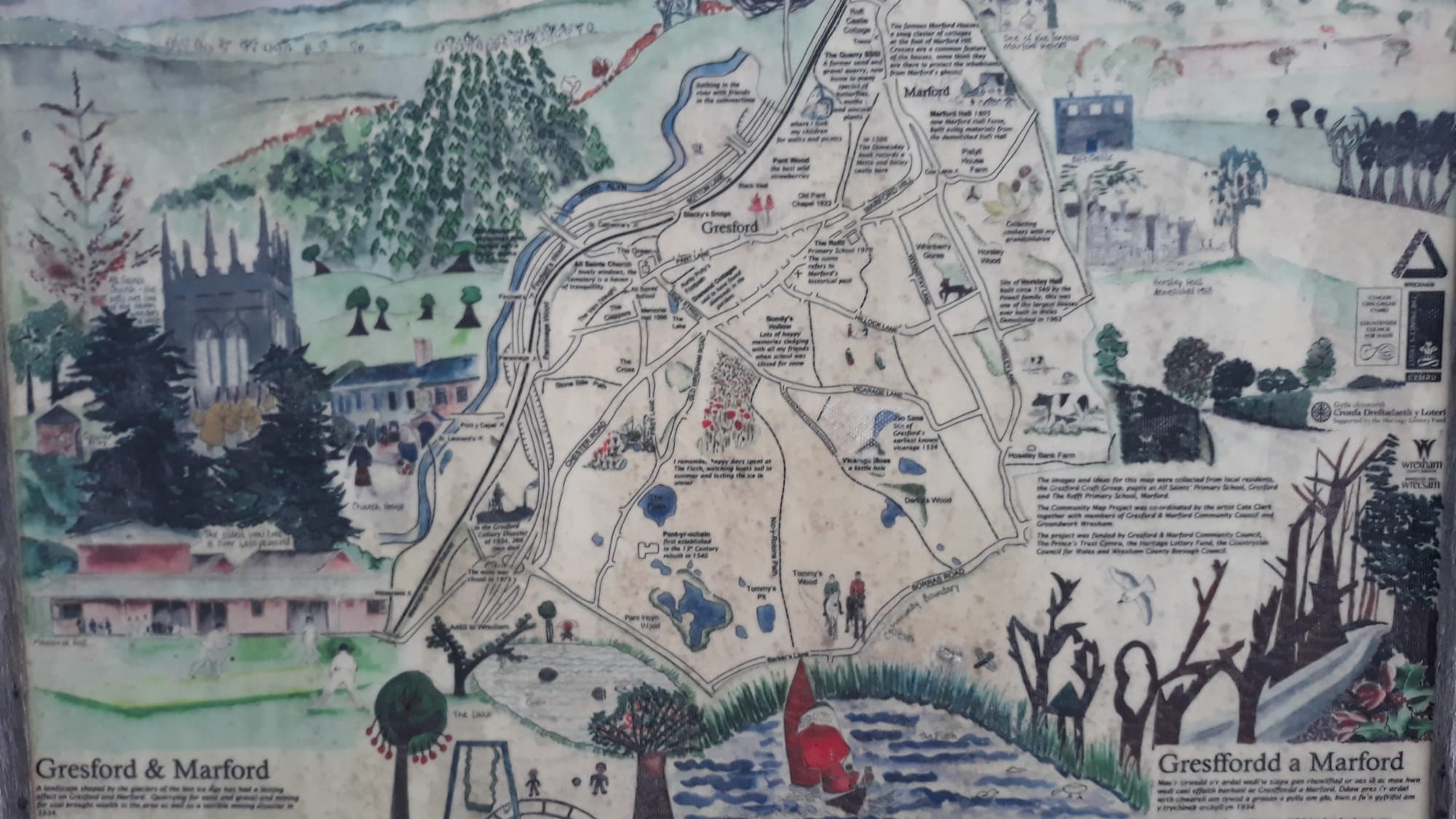
Drive north out of Wrexham on the old Chester road and the town gives way, almost without warning, to sandstone, yew trees and a church tower that looks too grand for a village. This is Gresford, and running on from it down the hill towards the Cheshire Plain is its smaller neighbour, Marford. Together they make one community of around five thousand people, and one of the most quietly desirable places to live on either side of the border.
The appeal is easy to list and hard to find elsewhere: good schools, a real village centre, walks straight from the front door, and the A483 a few minutes away, putting both Wrexham and Chester within easy reach. People move here for the commute and stay for everything else.
The finest parish church in Wales
Everything in Gresford seems to gather around All Saints' Church. Mostly built at the end of the 15th century in warm, slightly red sandstone, it's Grade I listed and often called the finest parish church in Wales. Its bells are one of the traditional Seven Wonders of Wales, praised for their tone for centuries, and they are still rung for services.
Step inside and look up at the east end, where Gresford keeps more medieval stained glass than any other church in Wales, some of it paid for by Thomas Stanley, Earl of Derby, around 1500. There are carved misericords, the alabaster tomb of Sion Trefor, and a Roman altar found in 1907, reused as building stone. Outside, the churchyard yews include one that was already ancient in the 14th century.
Two cities within twenty minutes, and a church whose bells are one of the Seven Wonders of Wales.
Gresford pond
A short walk from the church, Gresford's pond, known locally as Gresford Lake, is the village's favourite spot for a stroll and for feeding the ducks. It's also a lesson in how much a village cares about its green spaces. Decades of road run-off and silt, and carp introduced in the 1980s, left the water murky and stripped out much of its wildlife.
The volunteers of the Friends of Gresford Lake and Gresford Community Council have been fighting back. With a Welsh Government grant of more than £48,000 in 2023, they rehomed around a thousand carp, installed a solar-powered algae remover and planted thousands of reeds and native plants. The next goal is removing the silt. It's the kind of project that tells you a lot about the people who live here.
Marford Quarry: a nature reserve on the doorstep
Above Marford lies one of the most surprising nature reserves in Wales. Marford Quarry opened in 1927 to dig sand and gravel left by Ice Age meltwater, and some of it went into building the Mersey Tunnel. When the quarrying stopped in 1971, nature moved in.
Today it's a Site of Special Scientific Interest, cared for by the North Wales Wildlife Trust. Its warm, sandy slopes support more than 140 species of bees, wasps and ants, along with butterflies such as the dingy skipper. Come on a still summer's day, when the banks hum with insects. It's an easy walk from the village.
Good schools
For many families, schools are the reason they choose Gresford and Marford. The villages have two well-regarded primaries. All Saints' VA School in Gresford is a Church in Wales school that still uses part of its 1874 building; at its last full Estyn inspection, inspectors rated every area good, praising pupils' standards in writing, maths and spoken Welsh. The Rofft on Wynnstay Lane in Marford is the community primary for the north of the village.
Most older children go on to Darland High School in nearby Rossett. Catchments and admissions are set by Wrexham County Borough Council, so check the latest Estyn reports and catchment maps before you buy or rent.
Links to Wrexham and Chester
Gresford sits right beside the A483, which puts Wrexham city centre about 10 minutes away and Chester about 20. Buses run along the old Chester road between the two cities. The village had its own railway halt until 1964; today the nearest stations are Wrexham General, for trains to Chester, Shrewsbury and Cardiff, and Chester, for Manchester and London.
It's the in-between position that makes the villages work. Weekdays can mean an office in Chester or a commute to Manchester or Liverpool, while weekends mean a match at STōK Cae Ras, the walls and Rows in Chester, or the castles and aqueduct of the Dee Valley half an hour south.
Remembering 1934
Gresford's name is known far beyond Wales for a darker reason. On 22 September 1934, an explosion at Gresford Colliery killed 266 men, one of the worst disasters in British mining history; most of them were never recovered. The colliery's winding wheel now stands as the Gresford Disaster Memorial, and the hymn tune Gresford, the "Miners' Hymn", is still played by brass bands across the country.
Eating and drinking
The best-known table in the village is the Pant-yr-Ochain, a 16th-century manor house turned gastropub, with a long menu, real ales and gardens to sit out in on summer evenings. For more choice, Chester's Hoole and Wrexham's city-centre restaurants are both a short drive away.
Gresford & Marford essentials
- All Saints' Church
- Gresford village centre · Grade I listed; the bells are one of the Seven Wonders of Wales.
- Gresford pond
- Gresford Lake · Ducks, benches and a long-running community restoration project.
- Marford Quarry
- North Wales Wildlife Trust nature reserve and SSSI · Bees, butterflies and woodland paths.
- Gresford Disaster Memorial
- The colliery winding wheel and plaque remembering the 266 men lost in 1934.
- Pant-yr-Ochain
- Old Wrexham Road · Gastropub in a 16th-century manor house.
- Schools
- All Saints' VA (Gresford) · The Rofft (Marford) · Darland High (Rossett).
Details checked 7 November 2026 using All Saints' Church, North Wales Wildlife Trust, Nation.Cymru and Estyn. Distances are approximate. Check schools and catchments with Wrexham Council.